FAO launches four-year holistic program to save Urmia Lake
TEHRAN (Basirat)- FAO signed an agreement on Tuesday (6 September 2016), with the Urmia Lake Restoration Commission (ULRC) in Tehran at Sharif University of Technology to lend substantive technical assistance for the execution of an integrated programme that aims ultimately to secure sustainable water resources management in the Urmia Lake basin.
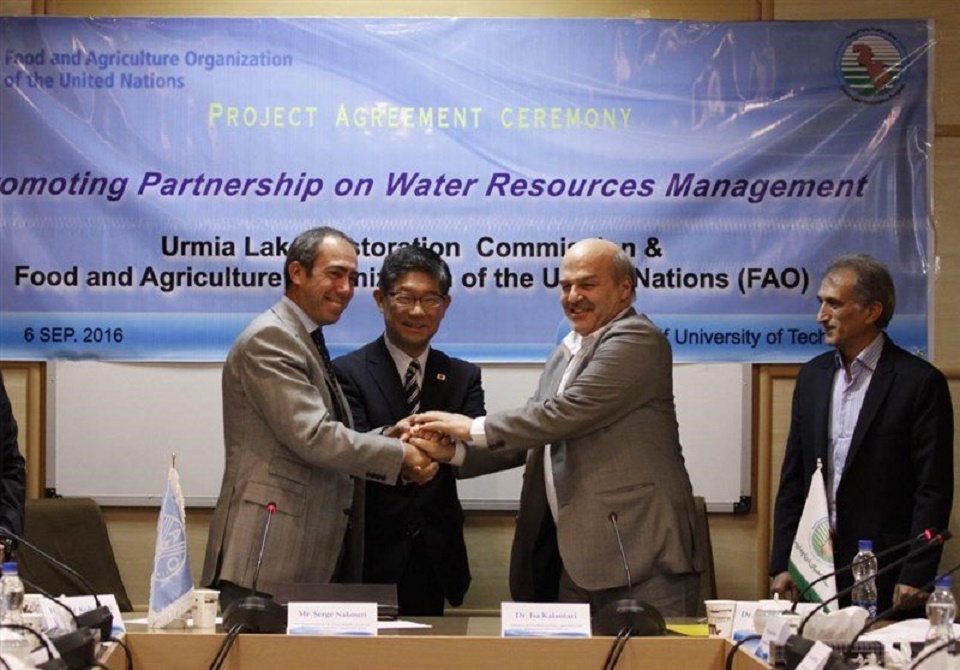
FAO signed an agreement on Tuesday (6 September 2016), with the Urmia Lake Restoration Commission (ULRC) in Tehran at Sharif University of Technology to lend substantive technical assistance for the execution of an integrated programme that aims ultimately to secure sustainable water resources management in the Urmia Lake basin.
At the ceremony, Mr. Serge Nakouzi, the FAO Representative to the Islamic Republic of Iran and to the Economic Cooperation Organization (ECO), and Dr. Issa Kalantari, Adviser to the Iranian President on Water, Agriculture and Environment and Secretary of Urmia Lake Restoration Commission (ULRC) signed the agreement and the project documents in the presence of His Excellency Hiroyasu Kobayashi, Ambassador of Japan to Iran.
"The project will accelerate halting and inverting the lake’s drying-up process by targeting reduction of water consumption within the Urmia Lake basin” the FAO Representative said.
Mr. Nakouzi underscored that through the implementation of the
Programme, the concerned stakeholders will be empowered with tools and
methodologies to monitor water consumption, agricultural water
productivity and drought, while enhancing their capacity to disseminate
Good Agricultural Practices (GAP) in agricultural water management.
The joint FAO – ULRC Programme that entitled "the Integrated Programme
for Sustainable Water Resources Management in the Lake Urmia Basin” also
comprises a socio-economic component that seeks to promote sustainable
alternative income-generating solutions.
The Programme which funded by the Government of Japan with 436 million
Japanese Yen (approx. 3.8 million USD), will be implemented by the
Government of Iran with the support of the FAO technical and operational
team, fully integrated within the existing governance of the Urmia Lake
Restoration Programme (ULRP) and in close cooperation with different
partners, selected on the basis of multidisciplinary requirements.
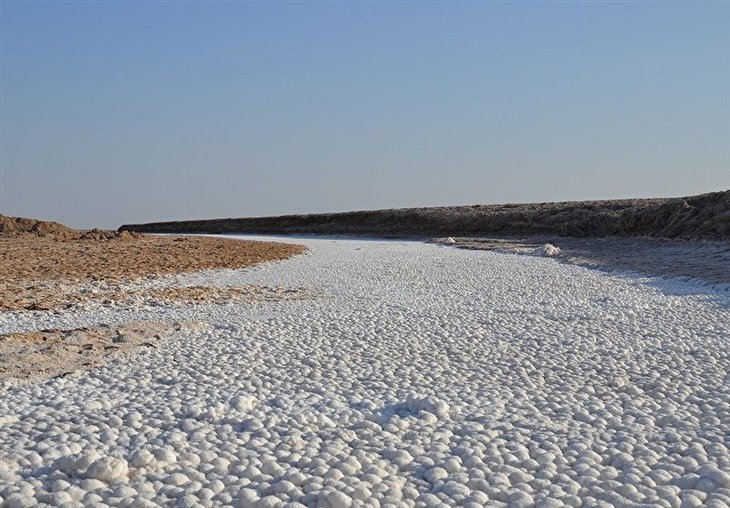
The area and volume of Urmia Lake is the resulting net balance of the
amount of inflowing and outflowing water. For hundreds and perhaps
thousands of years, the Urmia Lake was in balance with its water supply
from the watershed, but recent increases in agricultural, industrial and
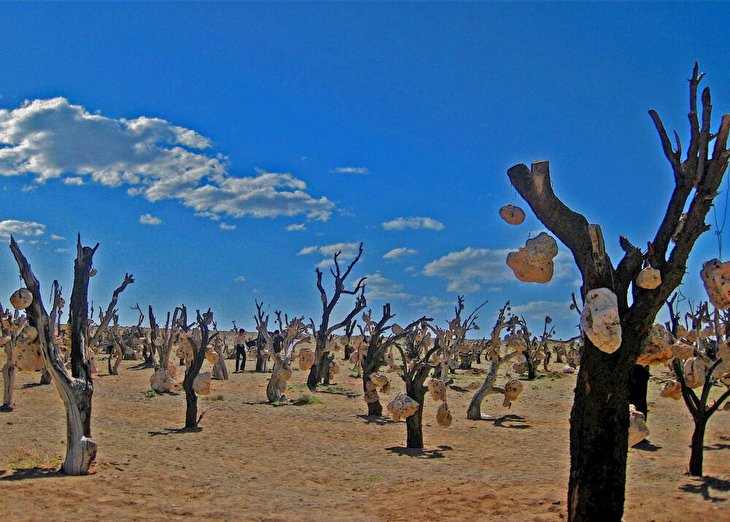
municipal water withdrawals have disturbed the balance and the Urmia
Lake is drying up. Consequently, the most urgent need is to restore the
water inflow to the Urmia Lake.
Following an official communication from the ULRC to the FAO
Representation in the Islamic Republic of Iran, expressing concerns for
the extreme water depletion/degradation of the Urmia Lake and requesting
Organization’s assistance in finding possible solutions to the problem,
a multidisciplinary mission was organized in February 2015 to respond
to this request.
A rapid assessment on the status and prospects of the Urmia Lake was
conducted by a team of FAO experts within the framework of the FAO
Regional Initiative on Water Scarcity, as Islamic Republic of Iran
became one of the recent focus countries of the Regional Initiative.
The findings of such a rapid assessment reaffirmed that the restoration
of Urmia Lake is firmly anchored to the whole-basin water balance
(inflow-outflow), particularly through addressing the dual core
challenges of firstly, reducing water consumption of development
activities upstream the lake; and secondly, managing drought, climate
variability, and related risks for reduced precipitations.
Inter-basin water transfer would represent an additional variable of the
water-balance equation, provided proper impact assessment is carefully
considered. Water quality deserves due attention as well.
The ultimate beneficiaries of the project will be the Urmia Lake basin
communities, who will benefit from information and decision support
systems to target interventions reducing water consumption while
restoring the Urmia Lake and its wetlands.
Throughout implementation of the project, special emphasis will be given
to the inclusion of valuable alternative income-generation scenarios
and employment options, cropping system revisions, and value chain
improvement for farmers, rural population, and other socio-economic
entities, to achieve the pre-determined target of water consumption
reduction.