Erdogan’s Plan to Grab More Powers Damages Already Plagued Turkish Economy
TEHRAN (Basirat)- The intense debate in Turkey about transition from the country’s parliamentary democracy to a presidential system is having a negative impact on the national economy, Turkish economist and journalist Erdal Saglam told Sputnik.
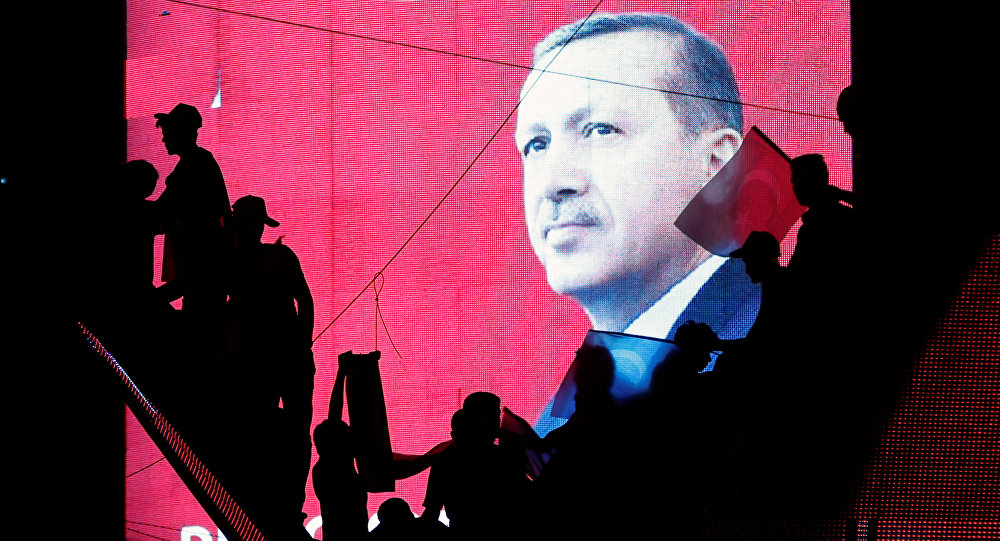
The intense debate in Turkey about transition from the country’s parliamentary democracy to a presidential system is having a negative impact on the national economy, Turkish economist and journalist Erdal Saglam told Sputnik.
The debate around the possible reform has created an extra source of tension and instability in the economy. Recently, Turkey revived calls for a constitutional referendum to expand the powers of the Turkish president.
The debate around the possible reform has created an extra source of tension and instability in the economy. Recently, Turkey revived calls for a constitutional referendum to expand the powers of the Turkish president.
In mid-October, Turkish Prime Minister and Justice and Development
Party (AKP) chair Binali Yildirim said that a proposal to replace
Turkey's parliamentary democracy with a presidential system is expected
among a set of constitutional reforms the ruling party is planning.
The calls have sparked public outrage and faced protests from Turkish opposition parties. However, despite foreign and domestic concerns, President Recep Tayyip Erdogan is set to hold a referendum to accumulate more power in his hands.
The calls have sparked public outrage and faced protests from Turkish opposition parties. However, despite foreign and domestic concerns, President Recep Tayyip Erdogan is set to hold a referendum to accumulate more power in his hands.
Erdogan happens to have in the same very hands the judicial power,
parliament and government. He controls the prime minister and can oust
him, Turkish public official, publicist and writer Baskın Oran told
Sputnik Turkiye.
"The issue has added to the existing debates over Turkey’s role in combat actions in Syria and Iraq amid an ongoing economic downturn," Saglam said in an interview with Sputnik Turkiye.
"The issue has added to the existing debates over Turkey’s role in combat actions in Syria and Iraq amid an ongoing economic downturn," Saglam said in an interview with Sputnik Turkiye.
The reason behind the slowdown in growth is that Turkey still lacks an "autonomous and capable production structure."
"The industrial production in Turkey is maintained from the outside with money inflows. But we see that the economy is slowing down due to a drop in capital inflows to Turkey. The reasons are global economic trends as well as Turkish domestic political and economic problems," the economist pointed out.
"The industrial production in Turkey is maintained from the outside with money inflows. But we see that the economy is slowing down due to a drop in capital inflows to Turkey. The reasons are global economic trends as well as Turkish domestic political and economic problems," the economist pointed out.
Earlier this year, the Turkish government predicted a five percent
growth, but then the outlook was adjusted to three percent. This has had
a direct impact on people and their consumption.
"This trend is more visible in certain sectors, and in some it is less visible. But overall it is having a negative impact on the economy. Many major companies have been shutting down. We need effective management and clear vision of the problem to fix the situation. But the problem is being ignored," Saglam concluded.
"This trend is more visible in certain sectors, and in some it is less visible. But overall it is having a negative impact on the economy. Many major companies have been shutting down. We need effective management and clear vision of the problem to fix the situation. But the problem is being ignored," Saglam concluded.