Iran FM urges diplomacy, warns against ‘illusions’ on Syria
TEHRAN,(Basirat)- Iran’s Foreign Minister Mohammad Javad Zarif stresses the importance of pursuing a “political solution” to the Syria crisis, warning against entertaining “illusions” about the situation in the Arab country, Press TV reports.
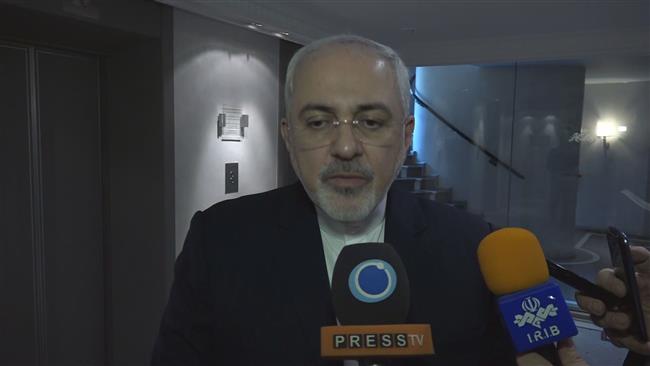
Zarif made the remarks in response to a question from
PressTV correspondent on Friday about Iran’s stance on the Saudi offer to send
ground forces into Syria and the recent US assertion about a "plan B” on
Syria.
"I think what is important for everybody is to focus on a
political solution and not on complicating factors particularly boasting about
situations that are more illusions than reality,” Zarif said on the sidelines
of a meeting of the International Syria Support Group (ISSG) in Munich.
The idea of Riyadh’s possible participation in ground
operations in Syria was first raised on February 4 by Ahmed Asiri, a
spokesman for the Saudi Defense Ministry.
Syrian Foreign Minister Walid al-Muallem slammed the
initiative, saying "coffins” await any aggressor in the country "whether they
be Saudis or Turks.”
On the eve of the Munich talks, US Secretary of State John
Kerry told The Washington Post that in case of lack of
seriousness by Russia and Iran for the resolution of the crisis in Syria,
"then there has to be consideration of a Plan B.”
He added that "Plan B” would consist of "a coalition against
(the Daesh Takfiri terrorist), and also to support the opposition against
Assad.”
Zarif further said despite the agreements during the Syria
talks in Munich, the sides faced "conceptual” disagreements.
"Whether some of the countries in the region continue to
believe that these terrorist, extremist organizations constitute a bargaining chip
for them, whether they can even provide short term advantage or whether they
can wake up and see that these are threats first and foremost against them
before they are even a threat against the rest of the region,” the Iranian
foreign minister pointed out.
"But the agreement generally is to have a comprehensive
humanitarian assistance and comprehensive cessation of hostilities which if
implemented is a step in the right direction,” he said.
He added that there are currently "major challenges” to the
Syrian issue because it would be "very difficult” to distinguish some of these
organizations from "known terrorist and extremist organizations.”
"Everybody agrees that known terrorist and extremist
organizations are not going to be a part of the ceasefire,” Zarif said.
The Iranian foreign minister reiterated the Islamic
Republic’s stance, saying, "As I said, again, first and foremost it is
important for everybody to realize that there is no military solution to the
problem in Syria.”
"That terrorists and extremists are no leverage for anybody
against others and everybody should cooperate and abandon the wishes that they
could impose a solution on the Syrian people and should allow the Syrians and
facilitate for the Syrians to engage in a negotiation to end this crisis,”
Zarif added.
Hopes for ‘wise’ solution to Syria crisis
In a televised interview on Friday, Zarif expressed
hope that the outcome of the Munich meeting on the Syrian crisis will lead
to a wise approach that would end the suffering of people.
"I hope that the Munich negotiations will lead to a wise
solution through the acceptance of realities by those who have kept, with their
illusions, the Syrian people in pain and suffering and killing and
homelessness,” he said.
He also hoped that the meeting would manage to end the
"humanitarian catastrophe” in Syria.
Zarif meeting Russian, Chinese counterparts
In a Friday meeting between Zarif and his Russian
counterpart Sergei Lavrov on the sidelines of the Munich meeting, the two
foreign ministers stressed the importance of further development of relations
in favor of mutual interests.
"They discussed topical issues of bilateral cooperation
and exchanged views on a number of issues of international and regional
policy," Russian Foreign Ministry said.
"The mutual disposition to further strengthening of
Russian-Iranian cooperation in the interests of ensuring stability and security
in the Middle East region was reaffirmed," the ministry added.
In a separate meeting on Friday, Zarif and China’s Foreign
Minister Wang Yi discussed the latest situation in Syria and ways to improve
Tehran-Beijing relations.
The Chinese minister said that all parties should
"abandon military methods in order to settle the Syrian issue by political
means," RIA Novosti reported.
"I hope that Iran will play an active and constructive
role here," he added.
Wang also called on Iran and China to deepen cooperation.
Zarif meeting IAEA chief, top officials
The Iranian foreign minister held separate meetings with
Director General of the International Atomic Energy Agency (IAEA) Yukiya Amano
and a number of senior officials on the sidelines of the Munich Security
Conference (MSC) on Friday.
Zarif sat down with Slovenian President Borut Pahor, Iraqi
Prime Minister Haider al-Abadi, foreign ministers of Netherlands Bert
Koenders, Ukraine Pavlo Klimkin and Georgia Georgy Kvirikashvili as well as
former United Nations Secretary General Kofi Annan.
He also met with Pakistani Defense Minister Khawaja Asif and
Deputy UN Secretary General Jan Eliasson.
source:Presstv