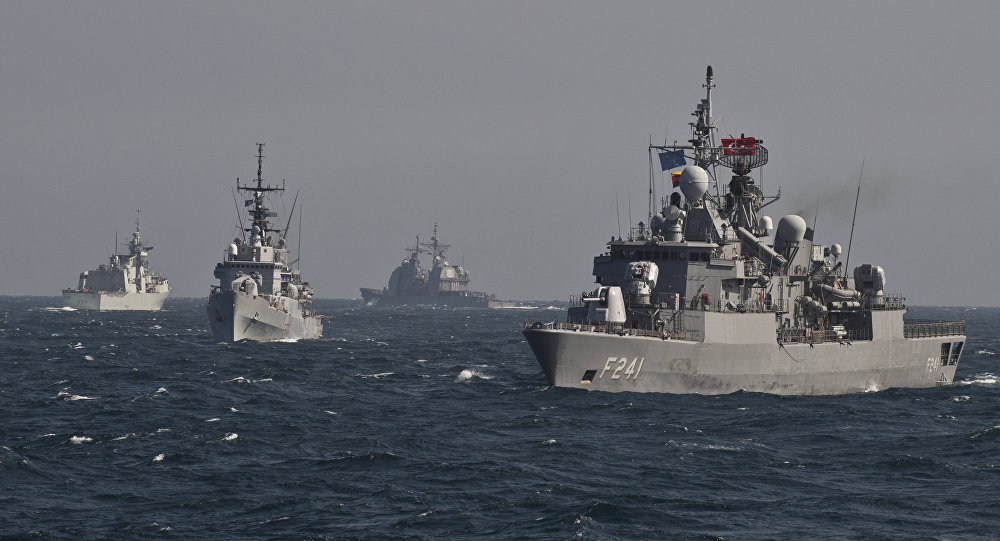
And that, it suggests, would be NATO’s presence in the Black Sea.
"Before the plane, Turkey fiercely resisted efforts by member states,
especially the US, Bulgaria and Romania, to have an increased military
presence in the Black Sea,” it says.
Ankara has not allowed any exception to the restrictions stated
in the Montreux Convention, a 1936 agreement that gave Turkey control
over the Bosporus Straits and the Dardanelles and set the regulations
on the transit of naval warships.
The newspaper then recalls the recent remarks of the Turkish president.
Does that mean that Turkey’s decades-long policy of keeping Montreux intact will be changing?” the outlet wonders.
"Turkish officials are trying to get an answer
to that question as well; something they should get used to, since it
seems Turkey’s policy changes have become to depend on the two lips
of one person,” it further suggests.
However it proffers that it will be highly unlikely to see any
deviation from the imperatives of the Montreux treaty. Even though
countries like Romania continue to push for a "forward presence,” in the
Black Sea.
The newspaper though suggests a formula that ensures NATO presence in the Sea without violating the convention.
Turkey could send several of its warships
in the Black Sea operating under the banner of a NATO mission. That
could secure a NATO presence there without violating the Montreux
Convention.
But Turkey can find it hard to convince its allies on such a formula,
since some members won’t like the idea of NATO getting embroiled in a
collision course between Turkey and Russia in the Black Sea, it says.
After all, some NATO members are still not convinced by the arguments
provided by Turkey on why Turkish jets had to down the Russian plane, it
says.
Anyway, the newspaper notes, the "Russian
question” will top the agenda and the major challenge will be to reach
consensus on it, since some of the member states have a completely
different relations with Moscow.
Thus, it says, Eastern European states, led by the Baltic states and
Poland, want a more "aggressive” response by strengthening NATO’s
deterrence capabilities against Russia.
The western European states, led especially by Germany, are aware of "Russia’s increasing assertiveness.”
Yet they are not on the same page with the eastern European states
in terms of the "threat perception” and want to avoid an escalation that
could be triggered by NATO’s response, instead preferring a more
calibrated approach.
The southern countries, in turn, feel there is too much focus
on Eastern Europe and want more attention to be paid to challenges
coming from the south, like the threats posed by Daesh and the refugee
crisis.
The outcome of the Summit is yet to be seen.