Can a country breed terrorism and try to end it at the same time?
TEHRAN (Basirat)- Minister Adel al-Jubeir leaves after a news conference at the Saudi Arabian Embassy in Washington, Friday, July 15, 2016, after the U.S. released once-top secret pages from a congressional report into 9/11 that questioned whether Saudis who were in contact with the hijackers after they arrived in the U.S. knew what they were planning.
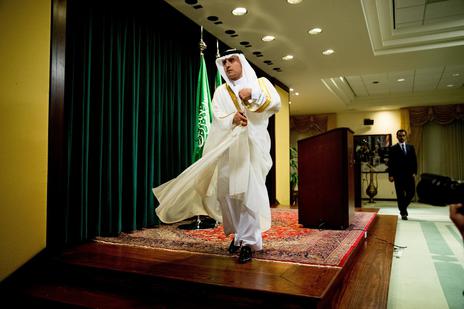
Minister Adel al-Jubeir leaves after a news conference at the Saudi Arabian Embassy in Washington, Friday, July 15, 2016, after the U.S. released once-top secret pages from a congressional report into 9/11 that questioned whether Saudis who were in contact with the hijackers after they arrived in the U.S. knew what they were planning.
deseretnews.com reports:
Saudi Arabian leaders are "both the arsonists and the firefighters" in the global war on terror, according to a recent article from The New York Times.
The country's unique brand of Islam, which it has spread throughout the world, encourages violence against nonbelievers, the author explains. And yet, in recent years, Saudi policy has shifted to encourage interfaith understanding and tolerance.
"Is the world today a more divided, dangerous and violent place because of the cumulative effect of five decades of oil-financed proselytizing from the historical heart of the Muslim world? Or is Saudi Arabia, which has often supported Western-friendly autocrats over Islamists, merely a convenient scapegoat for extremism and terrorism with many complex causes — the United States' own actions among them?" reporter Scott Shane asks.
He spoke with three dozen experts on Islam and foreign policy, trying to piece together whether it's fair to blame Saudi Arabia for the rise of the Islamic State.
"The idea has become commonplace: that Saudi Arabia's export of the rigid, bigoted, patriarchal, fundamentalist strain of Islam known as Wahhabism has fueled global extremism and contributed to terrorism," he wrote.
Many scholars agree with this assessment, noting that Wahhabism primes young people for extremism.
"There's only so much dehumanizing of the other that you can be exposed to — and exposed to as the word of God — without becoming susceptible to recruitment," said David Andrew Weinberg, a senior fellow at the Foundation for the Defense of Democracies, to The Times.
Saudi Arabia is on the U.S. Commission on International Religious Freedom's list of "Countries of Particular Concern," and USCIRF leaders are skeptical of the country's attempts to improve its religious freedom record.
"Saudi Arabia remains uniquely repressive in the extent to which it restricts the public expression of any religion other than Islam," USCRIF noted in its 2016 annual report.